

Vation Community Insights: 2025 AI Landscape Key Findings and 2026 Expectations

Ian Murphy
Director, Strategic Relationships

December 1, 2025

5 min
Setting realistic AI expectations for 2026 starts with understanding the current reality across organizations. We turned to our Innovation Advisory Council, a network of technology executives, to better understand three critical questions: who's deciding on AI projects, where the funding originates, and how many use cases organizations are actively exploring. By leveraging the technology CXO perspective, these insights help shape realistic expectations for AI adoption as we move into 2026.
This article was developed in collaboration with our partners at Mayfield, whose insights and expertise helped shape the direction of this research. Together, we designed the survey questions and discussion topics that were shared during our Innovation Advisory Council sessions, where technology executives explored how AI is being prioritized, funded, and scaled across their organizations.
A special thank you to Gamiel Gran, Chief Commercial Officer at Mayfield, for sharing his perspective throughout this piece. His investor lens and experience working with growth-stage companies brought an invaluable dimension to understanding how AI strategies are evolving across both the enterprise and venture ecosystems.
This collaboration reflects our shared commitment to helping organizations move beyond AI experimentation toward practical, responsible adoption that creates real business value.
Key Takeaways:
- Business Leaders Drive Practical AI Adoption: Line of Business (LOB) leaders are the primary non-technology decision-makers for AI projects, signaling that the most valuable and high-impact applications are those focused on solving specific business problems and delivering tangible operational value, moving AI focus away from purely IT-centric initiatives.
- Evolving AI Funding Model: While IT currently manages the initial budget for AI initiatives, the funding model is expected to shift toward decentralized and dedicated business unit allocations. As LOB-driven projects prove their worth, IT’s role will transform from sole budget owner to a crucial organizational enabler providing the robust platform for safe and effective deployment across the enterprise.
- Initial Scope Focuses on Trust and ROI: Organizations are adopting a measured approach by focusing on a limited, manageable number of AI use cases. This restrained scope is a strategic move to deliberately build internal organizational trust, demonstrate quick short-term ROI, and prove the successful internal process for moving AI initiatives into production before scaling to a broader, more complex range of applications.
AI Project Stakeholders: The Rise of the Line of Business

When it comes to making decisions about AI projects, we learned that Line of Business (LOB) leaders are the primary non-technology stakeholders involved in AI project decisions, with 52% participation. This engagement is significant because it highlights a clear organizational understanding that the power and ROI of AI will be found in specific, niche use cases that solve real business problems. By involving employees who are closest to the issues, organizations can empower LOB leaders to champion practical, high-value AI applications, moving beyond IT-centric projects toward initiatives that deliver tangible operational and business unit value.
While LOB owners lead the charge, executive teams across organizations are still involved in decision-making, indicating that there are numerous competing priorities for AI initiatives today. The challenge is that AI is currently not a purpose-built tool for specific use cases; it is an enabling resource designed to drive efficiencies and solve problems across the organization.
How are you seeing Line of Business (LOB) leaders influence AI adoption across your portfolio companies, and what makes this shift significant for investors?
“AI has unleashed a wave of innovative brainstorming and use cases driven largely by LOBs or business units. It's like the LOB leaders all caught onto the AI wave, realizing that they can do so much more with possible AI solutions to improve business operations (from customer support, marketing, finance, legal, operations, etc.) and they're eager to see how their CIO and AI technology teams can help.” – Gamiel Gran, Chief Commercial Officer at Mayfield
Funding AI Initiatives: Anticipating a Budget Shift
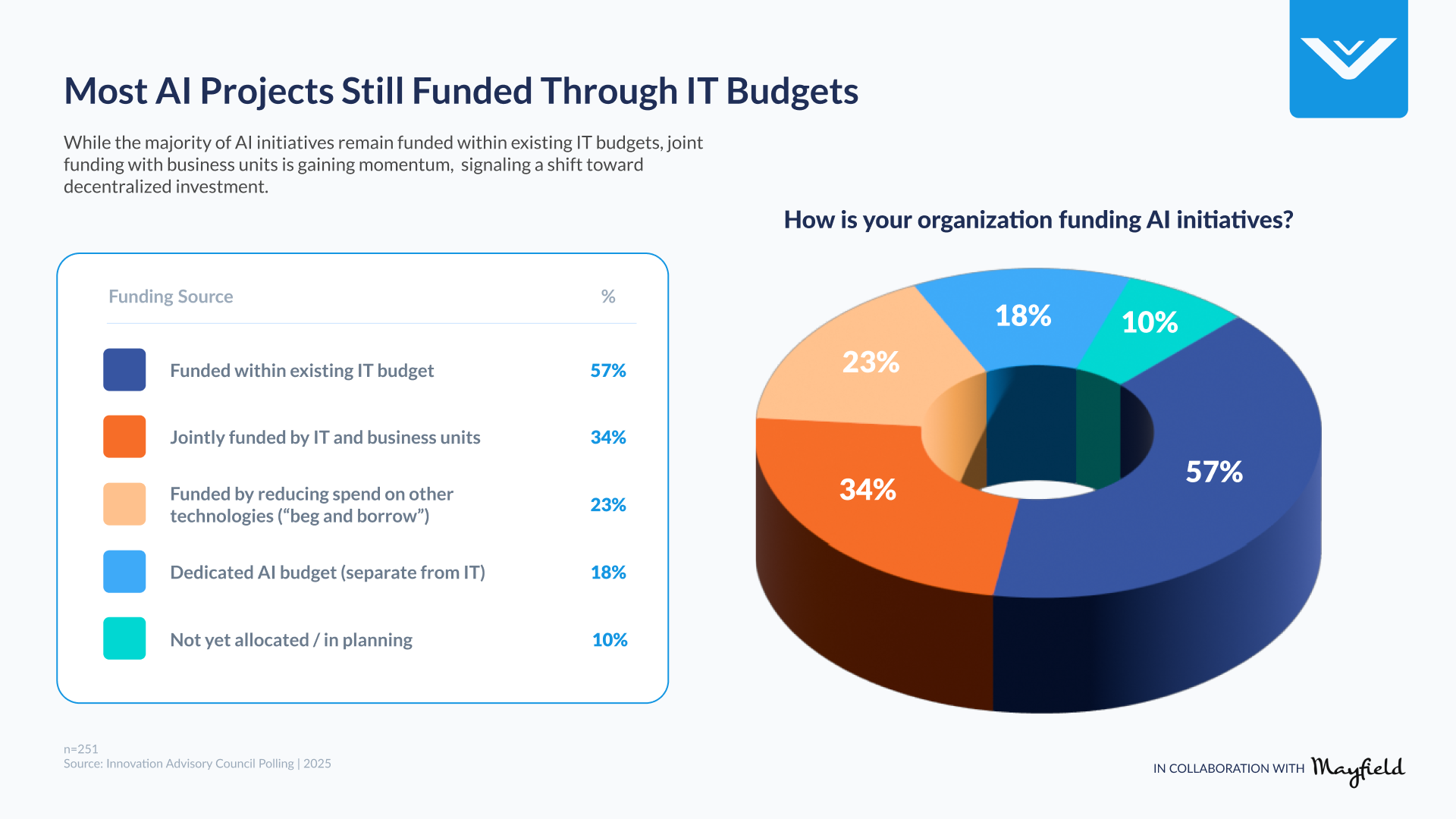
Currently, most AI initiatives are funded within the existing IT budget (57%) or as a joint effort between IT and business units. While this shows AI is often initially treated as an extension of the existing technology stack, we anticipate this funding model will change. As LOB leaders continue to identify and solve specific challenges within their business units using AI, these projects will naturally require budget allocations that are not merely extensions or pieces of the general IT budget. A growing number of specific, successful LOB use cases will likely lead to decentralized and dedicated AI funding coming directly from these business units, reflecting a more strategic, company-wide investment in the technology.
In the early stages, while IT holds accountability and manages the majority of the budget, its long-term role is transforming from the sole leader of AI implementation to a key organizational enabler. The new strategic imperative for IT is to provide a robust environment and platform that enables leaders to safely and effectively implement their specific AI initiatives, strengthening IT’s role as the foundation for scaled, successful AI adoption across the entire organization.
As AI budgets move from centralized IT control toward business-unit ownership, what implications do you see for enterprise investment strategies and AI-focused startups?
“First, AI funding is hot. Startups across the entire IT stack are getting chased by investors, and this is driving up valuations across the board.
As for budgets, we believe we are at the beginning of a very bullish spending cycle, whereby AI budgets will increase faster than traditional IT budgets. Further, we believe that CIOs will reallocate spending away from legacy solutions and toward AI spending.
And finally, the impact on enterprise strategy is a longer term thesis, but we are at the first stages of a fundamental shift from the current legacy x86-based infrastructure and SaaS applications to a new set of GPU-based, AI-enabled solutions. These will be powered by LLMs and Agents that become more of the core of the business application environment - but we are just getting started in a 5 year+ transformation.” - Gamiel Gran, Chief Commercial Officer at Mayfield
Scope of AI Use Cases: Practicality Over Pervasiveness

When asked about the number of AI use cases identified in an organization, we found that 34% of organizations are focusing on an identifiable and manageable 4-10 use cases for AI. This measured approach suggests a healthy relationship with the expectation of AI at this stage. Organizations appear to be focused on use cases that are practical, limited, and can deliver clear, demonstrable ROI. This constraint is likely due to an awareness of the time, money, and significant obstacles that even a seemingly simple, fully realized AI use case can involve, leading organizations to be more practical and constrained in their initial scope.
By focusing on limited, high-impact cases, organizations build crucial organizational trust in AI’s capabilities. Only once this process is proven and trust is established can the organization shift to a more scaled model for adopting a broader and more complex range of use cases.
From an investor’s perspective, how do you assess whether an organization or startup is approaching AI adoption in a scalable and sustainable way versus chasing hype?
"CIOs will have to remain focused on business impact, and less on the technology for the near term. Thus realizing that experimentation and prototypes will be common and their teams need to run fast. These early deployments will enable skills and process, and the technology stack will likely evolve along the way. So, lots of early adopter pilots to pave the way to long-term success." - Gamiel Gran, Chief Commercial Officer at Mayfield
Conclusion
We are at a strategic inflection point for AI adoption in 2026. As Line of Business leaders increasingly drive practical, problem-focused implementations, technology executives must evolve from budget gatekeepers to enablers of enterprise-wide innovation. The measured pace of starting with 4-10 targeted use cases isn't a limitation but a foundation for sustainable scale. Success in this new landscape requires building robust platforms that empower decentralized AI initiatives while maintaining governance, security, and integration standards. Organizations that can balance this enablement role with strategic oversight will be best positioned to transform early wins into enterprise-wide AI capabilities that deliver lasting competitive advantage.
As enterprises continue navigating this AI revolution, success will hinge on translating ambition into actionable, scalable outcomes. The insights from this survey, in collaboration with Mayfield, highlight that true progress depends on governance, alignment, and the ability to operationalize AI responsibly across every business unit.
At Vation Ventures, we help organizations move from experimentation to execution through our AI and Enterprise Consulting services, bridging strategy, data, and technology to accelerate adoption safely and effectively. From AI readiness assessments and governance frameworks to scalable deployment roadmaps, our team partners with enterprise leaders to drive measurable value from AI.
To learn more about how we can help your organization advance through the AI revolution, explore our AI Launchpad and enterprise consulting offerings here.


