
From Automation to Orchestration: Laying the Groundwork for Enterprise AI
Our IT Executive Roundtables are invite-only events hosted by peers for peers that bring together a select group of senior IT leaders from across industries for topic-driven, intimate dialog on current trends and topics. The group met remotely to discuss laying the groundwork for enterprise AI adoption. This Session was sponsored by Kamiwaza.


As organizations shift from early automation efforts toward more coordinated AI strategies, many are grappling with what it truly means to build a foundation that can support AI at scale. To explore this transition, leaders across industries joined a Virtual Executive Roundtable focused on moving from isolated tasks to orchestrated, agent-driven systems. The discussion centered on the practical realities of this evolution, including how data readiness, experimentation, cultural adoption, and governance shape an organization’s ability to turn AI from a series of pilots into a durable capability. Participants emphasized that success depends not just on deploying intelligent tools, but on creating the conditions for those tools to work reliably, responsibly, and in ways that meaningfully improve how teams operate.
This summary captures key takeaways on the priorities, challenges, and opportunities that define this shift toward enterprise AI orchestration.
Key Takeaways:
- AI maturity is shifting rapidly from “learning the tools” to “delivering business outcomes.”
A year ago, many organizations were still trying to get employees to understand how to use generative AI safely and productively. Now, the focus has moved toward using AI to automate specific steps in processes, support decisions, and detect valuable patterns without “betting the farm” on fully AI-run processes.
- Lowering the cost of experimentation is the cornerstone of enterprise AI orchestration.
Participants agreed that the immediate goal of an AI orchestration or agentic platform should be to reduce the friction (technical, governance, and cost) of trying new ideas. When organizations can safely experiment with agents close to their data, they can quickly validate small, high-impact use cases and build internal demand for more AI-powered problem-solving.
- Start with targeted automation and “biggest sources of toil,” not grand AI transformations.
Instead of trying to reinvent entire sales, finance, or customer processes with AI, leaders are finding success by targeting repetitive toil like routing tickets, prepping meeting materials, or syncing data across systems. Once teams see hours being restored to their week and low-cost wins, resistance decreases and creativity increases around where AI can help next.
- Data context, governance, and human-in-the-loop are make-or-break for agents at scale.
The hardest AI problems are not just about models, but about understanding domain-specific data, enforcing nuanced access, and closing the loop with experts. Organizations are experimenting with retrieval-augmented generation, role-based and policy-based controls for agents, simulated transactions, and expert review loops to ensure AI remains accurate, compliant, and trustworthy.
AI Maturity Is Shifting From Tool Familiarity to Business Outcomes
Organizations have moved quickly from basic AI literacy toward applying AI to targeted business challenges. Where the focus once centered on understanding generative tools and managing access, teams are now identifying specific workflow steps, decisions, and patterns where AI can reliably create value. This marks a shift from broad experimentation to grounded, outcome-oriented adoption.
This transition is reflected in the types of projects gaining traction, such as automation of discrete tasks, early pattern detection, and decision support, rather than full-scale reinvention of business processes. AI is becoming embedded in day-to-day operations, providing incremental improvements that lower friction and improve speed without introducing unnecessary risk.
Leaders remain intentionally pragmatic, pursuing a portfolio of small, validated wins rather than large, rigid commitments. This approach ensures organizations continue to advance along the maturity curve while retaining the flexibility to adapt as the AI landscape and regulatory environment rapidly evolve.
Lowering the Cost of Experimentation Is the Cornerstone of AI Orchestration
A major theme was that orchestrated AI environments should make experimentation easy, safe, and inexpensive. Because the AI ecosystem evolves quickly, it is impractical to design multi-year plans or rigid architectures. Teams instead emphasized infrastructure that abstracts away complexity, allowing rapid testing of ideas without major technical overhead.
This mindset has led many organizations to adopt agile delivery patterns: standing up early versions of agentic systems within weeks, shifting channels based on user behavior, and piloting with small groups before broader rollout. Running AI near existing data sources further reduces operational friction and accelerates discovery of viable use cases.
Human-in-the-loop processes play a key role. Many early agentic workflows involve agents proposing actions or simulating transactions while humans confirm or refine outputs. This builds trust, allows policies to mature alongside capabilities, and enables organizations to scale automation only where it is appropriate.
Progress Starts With Smart Automation and Everyday Friction Points
“Users think they can just type a prompt and get magic. We still need process, iteration, and specs before we hand anything over to the models.”
Instead of pursuing sweeping AI transformations, organizations are gaining traction by automating routine, high-friction tasks, such as routing service requests, preparing meeting materials, classifying tickets, and answering common questions. These targeted automations were previously difficult to justify but are now achievable at lower cost and shorter timelines with AI-enabled tools.
Service automation has emerged as a particularly strong early use case, with several teams deploying assistants that interface directly with existing systems. These early wins reclaim hours each week, reduce backlog pressures, and provide visible proof that AI simplifies work rather than complicates it.
A key barrier is behavioral rather than technical. Employees often expect instant results or feel uncertain about AI’s role. By helping teams understand the strengths and limits of the technology and by showing clear examples of reclaimed time, organizations are shifting attitudes from skepticism to curiosity. This creates a healthier, bottom-up pipeline of use cases aligned with real operational needs.
Data Context, Governance, and Human-in-the-Loop Are Non-Negotiable Foundations
“AI didn’t create our access problems; it exposed them. Now people finally see why those security policies matter.”
The most complex challenges in AI adoption relate to data: understanding domain-specific semantics, aligning context with models, and enforcing nuanced access controls. Many industries rely on internal terminology, structures, and relationships that models do not inherently recognize. Techniques such as retrieval-augmented generation and knowledge graphs are becoming essential to supply the context that practitioners rely on.
As agents access multiple systems, organizations are reevaluating governance models. Questions arise around what an agent should do on behalf of a user, how to constrain cross-system inference, and how to prevent unauthorized insight synthesis. These concerns are amplified in regulated sectors, where access constructs are tightly coupled to source systems and difficult to replicate consistently in AI layers.
Human oversight remains critical. Many teams rely on workflows where agents generate recommendations or summaries that humans confirm before action. As interfaces expand into voice and video, new considerations, like authentication, auditability, and session continuity, come into play. Notably, AI adoption is pushing organizations to strengthen existing governance structures, giving long-overdue clarity to roles, permissions, and data protections.
Polling Our Attendees
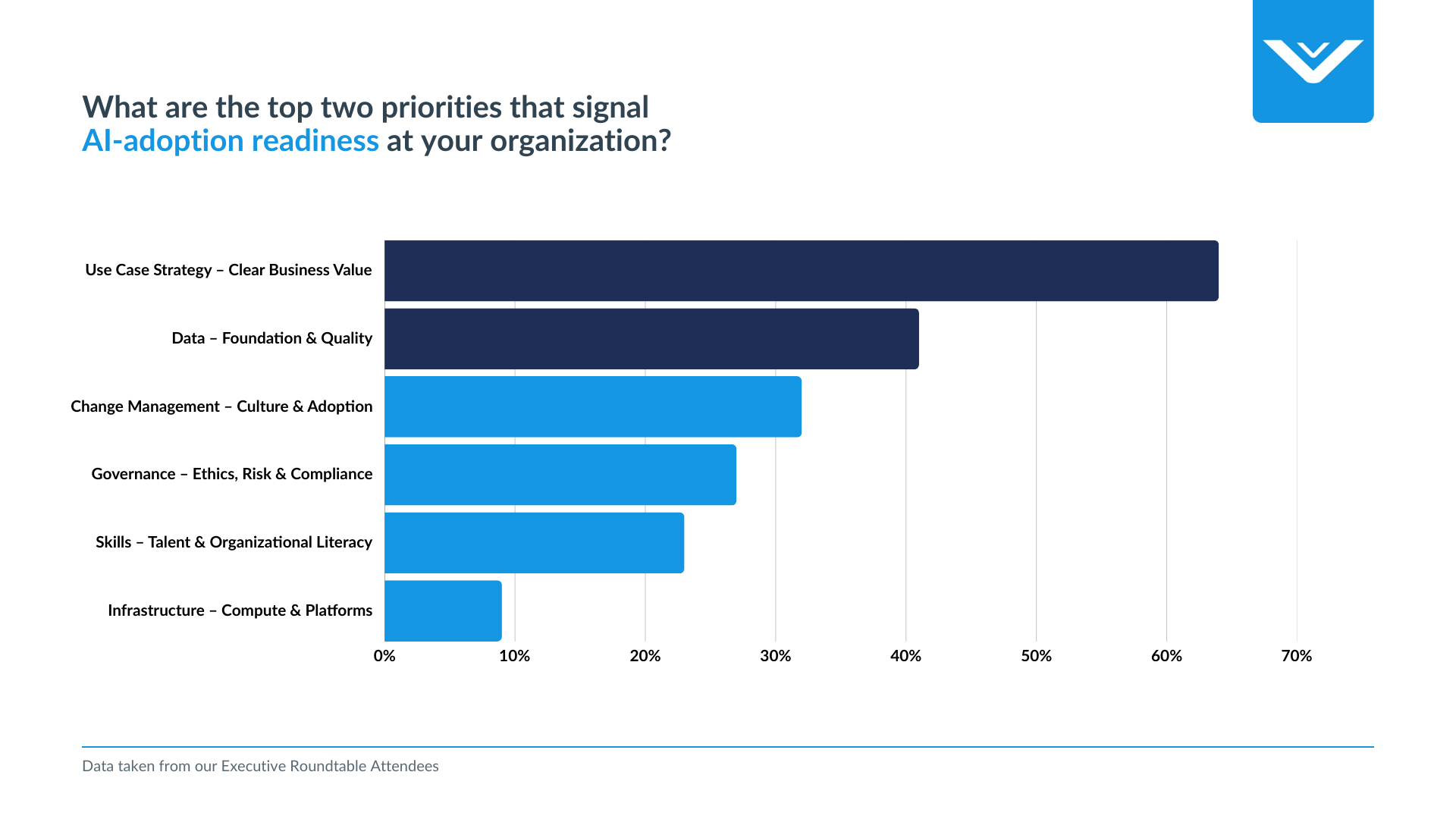
After polling our attendees, we’re seeing executives view clear business value as the strongest indicator of AI-readiness, with nearly two-thirds selecting Use Case Strategy as a top priority. This signals a shift away from broad experimentation toward focused, outcome-driven initiatives that solve specific problems and build internal momentum. Data Foundation & Quality ranked second, reinforcing that strong data infrastructure remains a critical enabler; leaders understand that even the best models cannot compensate for fragmented or unreliable data.
Responses also highlight that readiness is shaped by people and guardrails as much as by technology. Change Management and Governance both ranked highly, indicating that culture, adoption behaviors, and risk management continue to be essential to sustainable AI progress. Meanwhile, Infrastructure and Skills scored comparatively lower, suggesting that while organizations may feel they have adequate tools and baseline talent, the bigger differentiators now lie in aligning AI with business value, strengthening data foundations, and guiding teams through responsible adoption.
Conclusion
Organizations are ready to adopt AI with intention and clarity rather than speed alone. They are building the right foundations, choosing use cases that demonstrate real value, strengthening governance to reduce risk, and cultivating cultures that support experimentation. While the scope and pace of adoption may differ, the goal is consistent: to create AI-enabled systems that reduce friction, elevate decision-making, and unlock new operational possibilities without compromising trust.
To support organizations as they move from exploration to true AI orchestration, our AI Launchpad consulting service provides hands-on guidance in identifying use cases, structuring pilot programs, improving data readiness, and designing governance models built for scale. We’re grateful to partner with Kamiwaza in empowering leaders to take the next step toward sustainable, enterprise-wide AI capability. If your team is ready to advance with confidence, we’re here to help.
Thousands of executives stay at the forefront of innovation from our Sessions conversations.
Join them today.
Keep Reading
Shifting Towards Agility: Removing Fixed Capacity and Cost from Your Network
Agility in network engineering has become a core tenet for organizations striving to stay competitive. As businesses grapple with rapidly changing markets, fluctuating customer demands, and emerging technologies, the static models of yesteryears no longer suffice. Now, agility is a game-changer and a business imperative, enabling organizations to quickly adapt, scale, and innovate in line with evolving demands.
Access Management in a Disruptive & Digitally Transforming World
Multi-factor authentication (MFA) and one-time-passwords (OTPs) are being used to verify identities, some argue, at the cost of customer convenience. So how do you implement security controls for your customers without asking them to do too much?
Innovation Delivered to Your Inbox

